
Mathematical Concepts and LaTeX Examples
Mathematical Concepts and LaTeX Examples
This notebook demonstrates various mathematical concepts with LaTeX notation and visualizations using Python.
Topics Covered
- Basic calculus concepts
- Linear algebra
- Probability and statistics
- Fourier analysis
1. Calculus - Derivatives and Integrals
The derivative of a function $f(x)$ is defined as:
$$f’(x) = \lim_{h \to 0} \frac{f(x+h) - f(x)}{h}$$
For example, let’s consider the function $f(x) = x^2 \sin(x)$. Its derivative is:
$$f’(x) = 2x \sin(x) + x^2 \cos(x)$$
import numpy as np
import matplotlib.pyplot as plt
import seaborn as sns
from scipy import integrate

# Set up the plotting style
plt.style.use('seaborn-v0_8')
sns.set_palette("husl")

# Define the function and its derivative
def f(x):
    return x**2 * np.sin(x)

def f_prime(x):
    return 2*x*np.sin(x) + x**2*np.cos(x)

# Generate x values
x = np.linspace(-2*np.pi, 2*np.pi, 1000)

# Calculate function values
y = f(x)
y_prime = f_prime(x)

# Plot the function and its derivative
fig, (ax1, ax2) = plt.subplots(2, 1, figsize=(10, 8))

# Plot the function
ax1.plot(x, y, 'b-', linewidth=2, label='$f(x) = x^2 \sin(x)$')
ax1.set_title('Function $f(x) = x^2 \sin(x)$', fontsize=14)
ax1.set_ylabel('$f(x)$', fontsize=12)
ax1.grid(True, alpha=0.3)
ax1.legend()

# Plot the derivative
ax2.plot(x, y_prime, 'r-', linewidth=2, label="$f'(x) = 2x \sin(x) + x^2 \cos(x)$")
ax2.set_title('Derivative $f\'(x)$', fontsize=14)
ax2.set_xlabel('$x$', fontsize=12)
ax2.set_ylabel("$f'(x)$", fontsize=12)
ax2.grid(True, alpha=0.3)
ax2.legend()

plt.tight_layout()
plt.show()
<>:28: SyntaxWarning: invalid escape sequence '\s'
<>:29: SyntaxWarning: invalid escape sequence '\s'
<>:35: SyntaxWarning: invalid escape sequence '\s'
<>:28: SyntaxWarning: invalid escape sequence '\s'
<>:29: SyntaxWarning: invalid escape sequence '\s'
<>:35: SyntaxWarning: invalid escape sequence '\s'
/tmp/ipykernel_2802022/74342987.py:28: SyntaxWarning: invalid escape sequence '\s'
ax1.plot(x, y, 'b-', linewidth=2, label='$f(x) = x^2 \sin(x)$')
/tmp/ipykernel_2802022/74342987.py:29: SyntaxWarning: invalid escape sequence '\s'
ax1.set_title('Function $f(x) = x^2 \sin(x)$', fontsize=14)
/tmp/ipykernel_2802022/74342987.py:35: SyntaxWarning: invalid escape sequence '\s'
ax2.plot(x, y_prime, 'r-', linewidth=2, label="$f'(x) = 2x \sin(x) + x^2 \cos(x)$")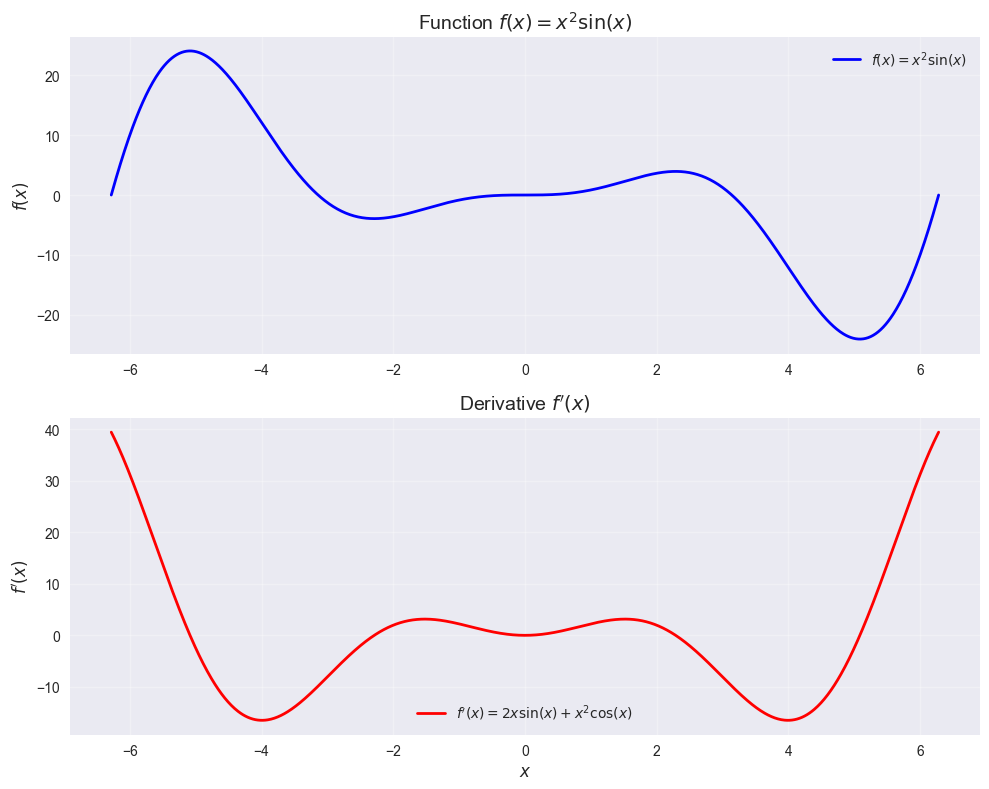
2. Linear Algebra - Eigenvalues and Eigenvectors
For a matrix $A$, an eigenvector $v$ and eigenvalue $\lambda$ satisfy:
$$Av = \lambda v$$
The characteristic polynomial is given by:
$$\det(A - \lambda I) = 0$$
# Create a sample matrix
A = np.array([[3, 1, 0],
              [1, 2, 1],
              [0, 1, 3]])

# Calculate eigenvalues and eigenvectors
eigenvalues, eigenvectors = np.linalg.eig(A)

print("Matrix A:")
print(A)
print("\nEigenvalues:")
for i, λ in enumerate(eigenvalues):
    print(f"λ_{i+1} = {λ:.4f}")

print("\nCorresponding eigenvectors:")
for i, v in enumerate(eigenvectors.T):
    print(f"v_{i+1} = {v}")

# Verify the eigenvalue equation Av = λv
print("\nVerification of Av = λv:")
for i, (λ, v) in enumerate(zip(eigenvalues, eigenvectors.T)):
    Av = A @ v
    λv = λ * v
    print(f"Eigenpair {i+1}: ||Av - λv|| = {np.linalg.norm(Av - λv):.2e}")
Matrix A:
[[3 1 0]
[1 2 1]
[0 1 3]]
Eigenvalues:
λ_1 = 1.0000
λ_2 = 3.0000
λ_3 = 4.0000
Corresponding eigenvectors:
v_1 = [ 0.40824829 -0.81649658 0.40824829]
v_2 = [ 7.07106781e-01 4.02240178e-16 -7.07106781e-01]
v_3 = [0.57735027 0.57735027 0.57735027]
Verification of Av = λv:
Eigenpair 1: ||Av - λv|| = 4.78e-16
Eigenpair 2: ||Av - λv|| = 2.62e-15
Eigenpair 3: ||Av - λv|| = 1.83e-15# Visualize the eigenvectors
fig, ax = plt.subplots(1, 1, figsize=(8, 6))
# Plot the eigenvectors
colors = ['red', 'blue', 'green']
for i, (λ, v) in enumerate(zip(eigenvalues, eigenvectors.T)):
ax.arrow(0, 0, v[0], v[1], head_width=0.1, head_length=0.1,
fc=colors[i], ec=colors[i], linewidth=2,
label=f'$v_{i+1}$ (λ_{i+1} = {λ:.2f})')
ax.set_xlim(-1, 1)
ax.set_ylim(-1, 1)
ax.set_aspect('equal')
ax.grid(True, alpha=0.3)
ax.set_title('Eigenvectors of Matrix A', fontsize=14)
ax.set_xlabel('$x_1$', fontsize=12)
ax.set_ylabel('$x_2$', fontsize=12)
ax.legend()
plt.show()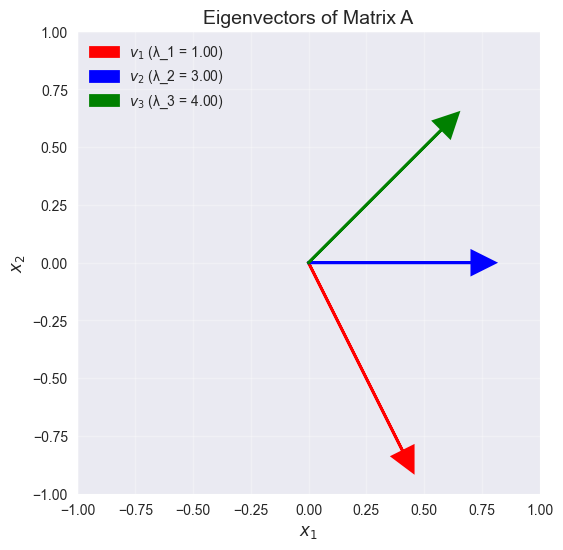
3. Probability and Statistics
Normal Distribution
The probability density function of a normal distribution is:
$$f(x) = \frac{1}{\sigma\sqrt{2\pi}} e^{-\frac{1}{2}\left(\frac{x-\mu}{\sigma}\right)^2}$$
where $\mu$ is the mean and $\sigma$ is the standard deviation.
from scipy import stats

# Define parameters for normal distribution
μ = 0  # mean
σ = 1  # standard deviation

# Create normal distribution
norm_dist = stats.norm(μ, σ)

# Generate x values
x = np.linspace(-4, 4, 1000)

# Calculate PDF and CDF
pdf = norm_dist.pdf(x)
cdf = norm_dist.cdf(x)

# Plot PDF and CDF
fig, (ax1, ax2) = plt.subplots(1, 2, figsize=(12, 5))

# Plot PDF
ax1.plot(x, pdf, 'b-', linewidth=2, label=f'N({μ}, {σ}²)')
ax1.fill_between(x, pdf, alpha=0.3)
ax1.set_title('Probability Density Function', fontsize=14)
ax1.set_xlabel('$x$', fontsize=12)
ax1.set_ylabel('$f(x)$', fontsize=12)
ax1.grid(True, alpha=0.3)
ax1.legend()

# Plot CDF
ax2.plot(x, cdf, 'r-', linewidth=2, label=f'N({μ}, {σ}²)')
ax2.set_title('Cumulative Distribution Function', fontsize=14)
ax2.set_xlabel('$x$', fontsize=12)
ax2.set_ylabel('$F(x)$', fontsize=12)
ax2.grid(True, alpha=0.3)
ax2.legend()

plt.tight_layout()
plt.show()

# Calculate some statistics
print(f"Mean: {norm_dist.mean():.4f}")
print(f"Variance: {norm_dist.var():.4f}")
print(f"Standard deviation: {norm_dist.std():.4f}")
print(f"Skewness: {norm_dist.stats('s'):.4f}")
print(f"Kurtosis: {norm_dist.stats('k'):.4f}")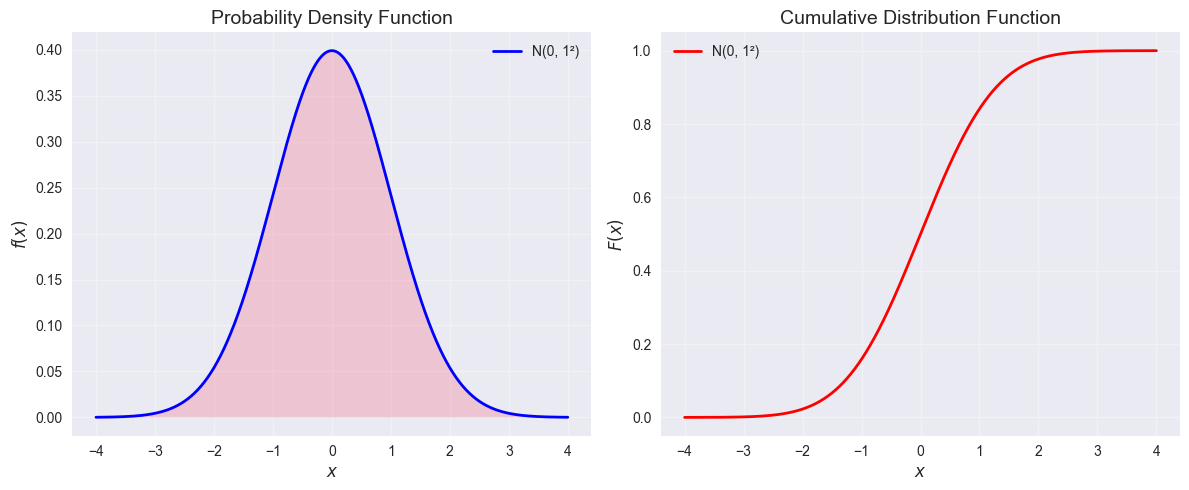
Mean: 0.0000
Variance: 1.0000
Standard deviation: 1.0000
Skewness: 0.0000
Kurtosis: 0.0000
Central Limit Theorem
The Central Limit Theorem states that the sum of $n$ independent and identically distributed random variables approaches a normal distribution as $n \to \infty$.
Mathematically: $\frac{\bar{X}_n - \mu}{\sigma/\sqrt{n}} \xrightarrow{d} N(0, 1)$
# Demonstrate Central Limit Theorem
def demonstrate_clt(sample_size, n_experiments, distribution='uniform'):
    """
    Demonstrate the Central Limit Theorem
    """
    sample_means = []

    for _ in range(n_experiments):
        if distribution == 'uniform':
            # Uniform distribution U(0, 1)
            samples = np.random.uniform(0, 1, sample_size)
        elif distribution == 'exponential':
            # Exponential distribution with λ = 1
            samples = np.random.exponential(1, sample_size)

        sample_means.append(np.mean(samples))

    return np.array(sample_means)

# Parameters
sample_sizes = [1, 5, 10, 30, 50]
n_experiments = 1000

# Generate sample means for different sample sizes
fig, axes = plt.subplots(2, 3, figsize=(15, 10))
axes = axes.flatten()

for i, n in enumerate(sample_sizes):
    sample_means = demonstrate_clt(n, n_experiments, 'uniform')

    # Plot histogram
    axes[i].hist(sample_means, bins=30, density=True, alpha=0.7,
                color='skyblue', edgecolor='black')

    # Overlay normal distribution
    x = np.linspace(sample_means.min(), sample_means.max(), 100)
    theoretical_mean = 0.5  # Mean of U(0,1)
    theoretical_std = np.sqrt(1/12) / np.sqrt(n)  # Std of U(0,1) / sqrt(n)
    normal_pdf = stats.norm.pdf(x, theoretical_mean, theoretical_std)
    axes[i].plot(x, normal_pdf, 'r-', linewidth=2, label='Normal approximation')

    axes[i].set_title(f'n = {n}', fontsize=12)
    axes[i].set_xlabel('Sample Mean', fontsize=10)
    axes[i].set_ylabel('Density', fontsize=10)
    axes[i].legend()
    axes[i].grid(True, alpha=0.3)

# Remove the last subplot (empty)
axes[-1].axis('off')

plt.suptitle('Central Limit Theorem Demonstration', fontsize=16)
plt.tight_layout()
plt.show()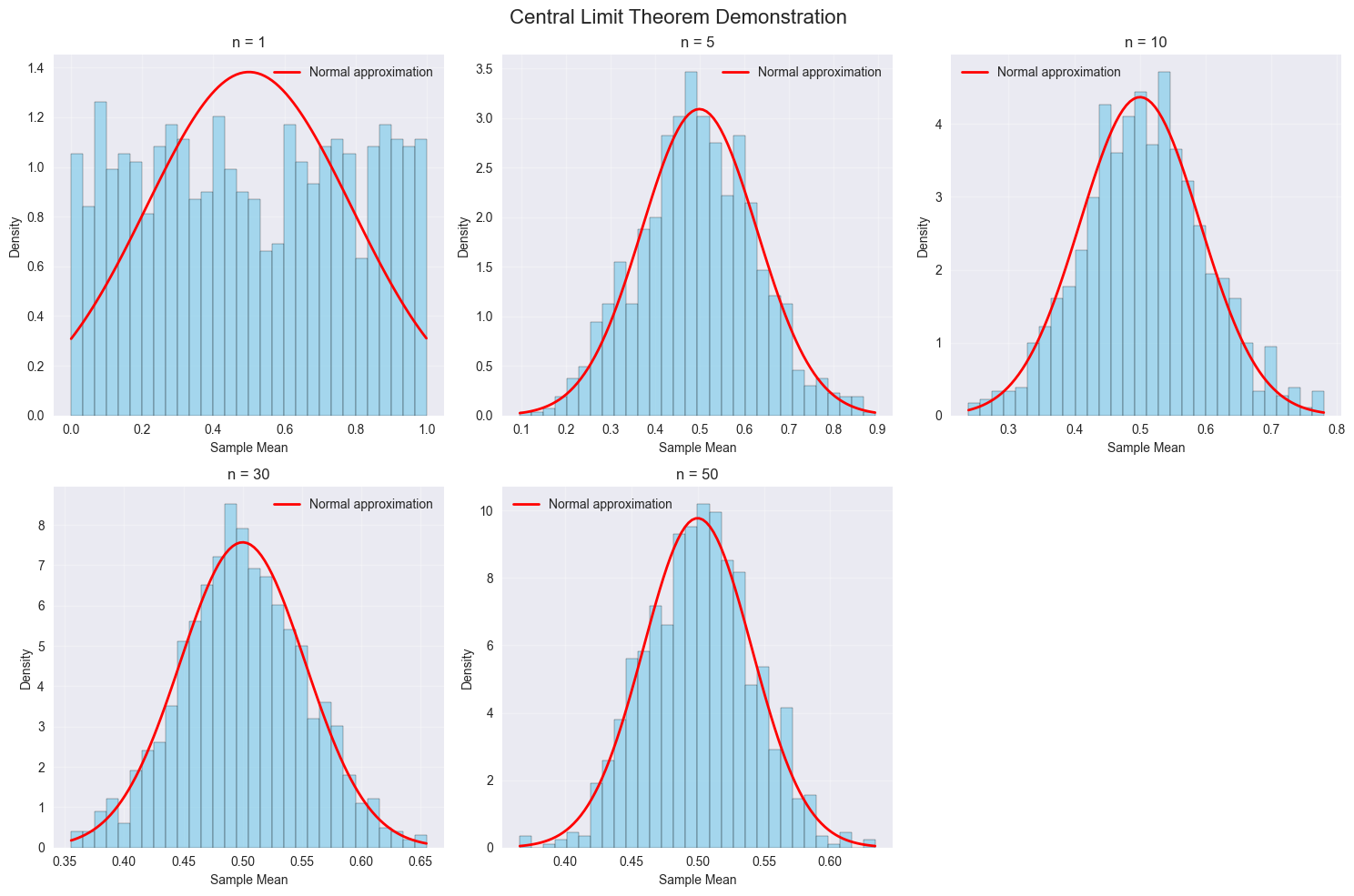
4. Fourier Analysis
The Fourier transform of a function $f(t)$ is defined as:
$$F(\omega) = \int_{-\infty}^{\infty} f(t) e^{-i\omega t} dt$$
The inverse Fourier transform is:
$$f(t) = \frac{1}{2\pi} \int_{-\infty}^{\infty} F(\omega) e^{i\omega t} d\omega$$
# Generate a composite signal
t = np.linspace(0, 2, 1000)  # Time vector

# Create a signal with multiple frequency components
signal = (np.sin(2 * np.pi * 1 * t) +           # 1 Hz component
          0.5 * np.sin(2 * np.pi * 3 * t) +     # 3 Hz component
          0.3 * np.sin(2 * np.pi * 5 * t) +     # 5 Hz component
          0.1 * np.random.normal(0, 1, len(t))) # Noise

# Compute FFT
fft_result = np.fft.fft(signal)
frequencies = np.fft.fftfreq(len(t), t[1] - t[0])

# Only keep positive frequencies
positive_freq_idx = frequencies > 0
frequencies = frequencies[positive_freq_idx]
fft_magnitude = np.abs(fft_result[positive_freq_idx])

# Plot the signal and its frequency spectrum
fig, (ax1, ax2) = plt.subplots(2, 1, figsize=(12, 8))

# Plot time domain signal
ax1.plot(t, signal, 'b-', linewidth=1)
ax1.set_title('Time Domain Signal', fontsize=14)
ax1.set_xlabel('Time (s)', fontsize=12)
ax1.set_ylabel('Amplitude', fontsize=12)
ax1.grid(True, alpha=0.3)

# Plot frequency spectrum
ax2.plot(frequencies[:50], fft_magnitude[:50], 'r-', linewidth=2)
ax2.set_title('Frequency Spectrum (FFT)', fontsize=14)
ax2.set_xlabel('Frequency (Hz)', fontsize=12)
ax2.set_ylabel('Magnitude', fontsize=12)
ax2.grid(True, alpha=0.3)
ax2.set_xlim(0, 10)

# Mark the known frequency components
for freq, amplitude in [(1, 2), (3, 1), (5, 0.6)]:
    ax2.axvline(x=freq, color='green', linestyle='--', alpha=0.7)
    ax2.text(freq, amplitude, f'{freq} Hz', rotation=90,
             verticalalignment='bottom', fontsize=10)

plt.tight_layout()
plt.show()

# Identify peak frequencies
from scipy.signal import find_peaks
peaks, _ = find_peaks(fft_magnitude[:50], height=0.1)
peak_frequencies = frequencies[peaks]
peak_magnitudes = fft_magnitude[peaks]

print("Detected frequency components:")
for freq, mag in zip(peak_frequencies, peak_magnitudes):
    print(f"Frequency: {freq:.2f} Hz, Magnitude: {mag:.2f}")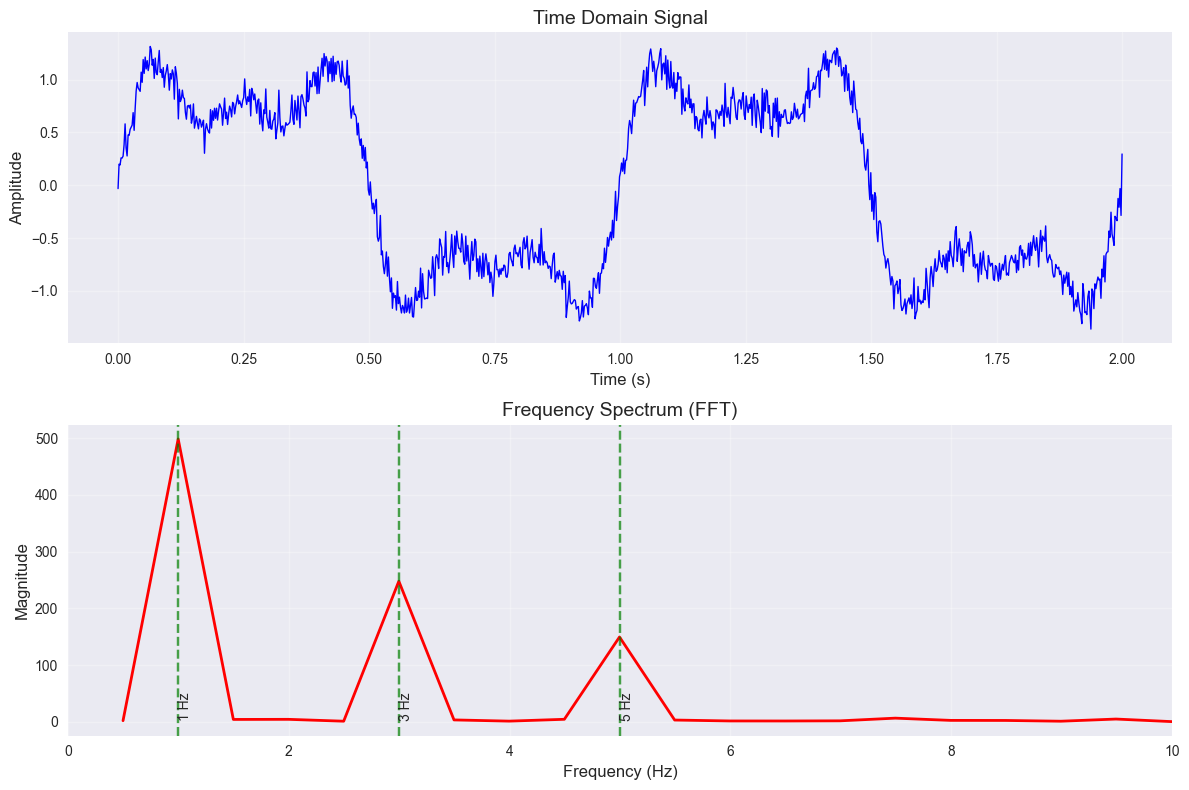
Detected frequency components:
Frequency: 1.00 Hz, Magnitude: 498.73
Frequency: 2.00 Hz, Magnitude: 4.35
Frequency: 3.00 Hz, Magnitude: 247.95
Frequency: 4.99 Hz, Magnitude: 149.55
Frequency: 7.49 Hz, Magnitude: 6.45
Frequency: 9.49 Hz, Magnitude: 4.86
Frequency: 11.99 Hz, Magnitude: 3.51
Frequency: 13.49 Hz, Magnitude: 5.52
Frequency: 14.49 Hz, Magnitude: 4.49
Frequency: 15.98 Hz, Magnitude: 4.24
Frequency: 16.98 Hz, Magnitude: 2.52
Frequency: 17.98 Hz, Magnitude: 3.71
Frequency: 19.48 Hz, Magnitude: 4.62
Frequency: 20.48 Hz, Magnitude: 4.22
Frequency: 22.48 Hz, Magnitude: 4.40
Frequency: 23.98 Hz, Magnitude: 3.12
Summary
This notebook demonstrated several important mathematical concepts:
- Calculus: Derivatives and their visualization
- Linear Algebra: Eigenvalues and eigenvectors
- Probability: Normal distribution and Central Limit Theorem
- Fourier Analysis: Signal decomposition in frequency domain
Each section included mathematical notation using LaTeX and corresponding Python implementations for visualization and computation.